

Could you tell us about yourself?
Nowadays I consider myself to strictly be a novelist. But over the course of my career, I’ve done all kinds of professional writing. I started out as an arts journalist and critic. For several years I was the editor of a weekly newspaper. From there I moved into trade journalism and copywriting for businesses. I was the promotional writer and occasional scriptwriter for a long-running PBS TV show, Newton’s Apple.
I roamed the U.S. as a travel writer. I covered consumer electronics for various publications. I had a book review column in the Minneapolis Star/Tribune for many years. I did medical writing for clients such as Mayo Clinic, and was on staff at a major med-tech firm. Throughout those years I picked away at writing novels; publishing a couple of mysteries through a vanity press. It’s only since 2012 that I’ve seriously applied myself as a novelist—producing three series and a solo mystery. That’s nine novels and two novellas. I’m currently working on two projects comprising four books—a fantasy trilogy and the fifth book in my historical mystery series. I write under my pen name Richard Audry and my real name D. R. Martin.
Can you tell us about your novels?
I have two mystery series and a ghost adventure series. My historical series—the Mary MacDougall Mysteries—revolves around a young heiress whose dream is to become a consulting detective. The period is the first years of the 20th century, the place Minnesota. The first two books were novellas and the last two novels. I’m working on a fifth book right now. My canine cozy series—the King Harald Mysteries—follows a recently divorced guy of about forty and his big, goofy pooch. The dog—who contributes his own POV to the stories—inadvertently involves his owner in various criminal cases. There are three novels in the series so far. Lastly, there’s my Johnny Graphic Adventures trilogy—a rip-roaring, steam-punky ghost adventure set in an alternative America of the 1930s.
What inspired you to write your books?
Ever since I was a kid, I loved to read. And I always thought it would be fun to create cool new stories out of thin air. It took me a while to actually do it; and a while longer to get good at it. I don’t make much money as a novelist, but by this point in my writing life, the money isn’t important. These days I write for the sheer pleasure of creating my own worlds and playing in them. Getting readers and making a few bucks is merely a bonus. I chose the genres I write in—cozy mystery, historical mystery, science fiction, fantasy—because these are things I enjoy reading and books that I’m confident I can pull off. There are other genres I also enjoy, but I don’t think I’d be good writing in them.
How many hours a day do you write?
I write on an old white Macbook. The battery lasts about two hours, so that’s usually the length of one of my writing sessions. And two hours a day is good enough, given that I face no particular deadlines. That’s typically 500 to 1000 words. I’m considering getting a new Macbook. I’ll be curious to see if longer battery duration inspires me to write more.
If you could spend a day with a popular author, whom would you choose and why?
At the top of my list would be Carl Hiaasen. There’s no one writing these days whom I enjoy more. His tales of gonzo humor and misbegotten criminality have always tickled me. I figure a day with him on some sunny Florida beach—lubricated by many fruity cocktails—would be a blast. I actually once had the great pleasure of spending a day with my then-fave author, Frank Herbert. I interviewed him for the newspaper I edited, we caught lunch, and ambled around in the rain for several hours. Then I saw him off to the airport in his taxi. It was every bit as great a time as you’d think it would be. What a brilliant, funny, thoughtful man. The encounter is written up in my little book, Four Science Fiction Masters (by D. R. Martin).
Who is your favourite author and why?
As a writer of crime fiction, I have special devotion to two mid-century masters. John D. MacDonald chronicled the dark and dangerous criminal corners and niches of American society, from the late-’40s through mid-’80s. He showed vividly how the lust for money and power and sex could so easily corrupt even good people. His protagonists and villains, even now, ring incredibly true. He’s best known for the 21-book Travis McGee series. McGee, a “salvage consultant,” helps folks get back the things that have been stolen from them—everything from money to reputation. His stuff can be a bit politically-incorrect, but it honestly reflects its era. Almost every other first-person gumshoe since then, starting with Spenser, owes a lot to McGee. My other favorite author is Georges Simenon, whose 80 Inspector Maigret mysteries do for France what MacDonald did for America. Austere, succinct, and moody, the typical Maigret tale is all about the ways people go wrong and how the inspector’s deep understanding of human psychology decodes their crimes. But those 80 Maigrets are only a fraction of his output; he wrote 320 other psychological novels.
How do you celebrate when you finish a book?
Nothing too elaborate. But I like to take my wife out to a fancy dinner—Italian is preferred—and toast the new title with a nice Merlot or Cabernet. And the toast is as much to celebrate her contributions as my own. She’s my number one editor, reader and critic, and adds immeasurably to each book. To her credit, she’s not the least afraid to tell me things I don’t want to hear; the kind of voice that’s invaluable to any novelist.
What’s your favourite writing snack or drink?
I don’t snack while I’m writing, but I like to have a cup of coffee or green tea close at hand. For a special treat, I’ll sometimes make a cappuccino run to the neighborhood coffee bar. Once in a while, I’ll set up shop there and work for a couple hours.
Where do you get the ideas for your books?
Each series arose differently. My Mary MacDougall Mysteries began with a viewing of the film A Room with a View, with Helena Bonham Carter as Lucy Honeychurch. We were watching the Sherlock Holmes series with Jeremy Brett about the same time, and I had an epiphany: Why not mash up Holmes with Lucy? From that came my heiress/sleuth Mary MacDougall. My King Harald Mysteries star a big, goofy Chesapeake retriever and his “boss” Andy Skyberg. Their story was inspired by my brother-in-law’s big, goofy Chesapeake retriever Gus.
What is your writing process like? And what’s the most difficult part?
Each book begins with some germ of an idea. For example, my most recent Mary MacDougall mystery, A Fatal Fondness, began with the image in my head of a drowned boy near the shore of a bay, found under the ice. Who was he? How did he end up there? Was it an accident or murder? How does Mary get involved? Then it gets complicated, growing from there, like tree branches spreading out. The thing that I find hardest is the plotting; the clockwork underlying the action and characters; the clockwork that makes the story go. And in addition to the main plot, there are two or three subplots. I’ve read many books on plotting and outlining, taken online courses, and so on. But for me the only thing that works is an arduous process of grinding it out over the course of many weeks—sometimes months. Usually, it takes a while before I arrive at something that works. It’s always painful, but comes with the territory. Generally, I end up bullet-pointing key events in the story. I need to get to this place…and this place…and this place…etc. What happens in between these waypoints is the fun part of writing; the improvisations that make a story come alive.
How do you develop your characters?
A few real humans and critters have inspired characters; but just a few. They’re mostly made up. So, I begin with types—that is, stock characters that we’re all familiar with. King Harald’s owner Andy is the decent guy who’s been emotionally and financially gutted by his recent divorce; so much so, that he retreats to his old home town. His twin sister—an ex-Silicon Valley type—is wealthy, smart, and an entrepreneur whose only speed is 100 mph. She gives him a job in her restaurant. Andy’s Aunt Bev is the energetic, well-meaning busybody who lands him in one fix after another. Andy’s BF is a crusty old boy named Thor Hofdahl who’s his sounding board on most everything; practically a sidekick. From those starting points, each character tells me who they are, and what they want to do. If I try to push them in a direction that’s untrue to them, they push back and let me know.
What’s your favourite and least favourite part of publishing your books?
The act of publishing an e-book is done at a great remove from anything notable. I’ve submitted my Word document and cover art to the Kindle system or Draft2Digital system (which distributes to multiple sellers), filled in all the required blanks, and clicked “Publish.” No fireworks go off, no confetti drops, no crowds cheer. In a day or two the book appears on sell pages. Not very exciting. A much bigger kick is getting the first paperback copies of the book. I can show it off proudly, send copies to reviewers, sell it on consignment at local bookstores. It’s quite a nice buzz, I can tell you—holding that book in your hand. But marketing and selling books among tens of thousands of competing books is a bear. Making a buck is exceedingly hard. It’s why most authors—both traditionally- and independently-published—only write a handful of books and then quit. Each book takes hundreds and hundreds of hours to write—and for some a couple thousand dollars out of pocket—and one would like a little reward for one’s hard work. Most authors don’t make much more than a buck an hour. Paid promotion, things like Book Bub, doesn’t work as well as it once did. Nor does social media. Getting professional reviewers to cover your book is hard. And most ordinary readers have become allergic to leaving online reviews. Even writing something as brief as “Loved it” or “Lotsa fun,” and clicking four or five stars, would be a big help. People can give a big boost to the authors they like by spending a minute or two leaving a brief, positive review. It definitely helps keep your favorite authors writing the books you love.
How did you come up with the titles for your books?
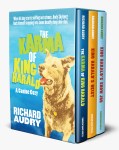
For my King Harald Mysteries, all that’s required is that the title include the pooch’s name and allude to something in the story. The Karma of King Harald…King Harald’s Heist…King Harald’s Snow Job. The first story involves a New Age retailer who happened to have been Andy’s old flame—thus “karma.” In Heist, Harald turns kleptomaniac. In the third book, Harald and Andy are snowed in by a blizzard during a bustling Christmas fair at a resort. Simple alliteration is the key to my Mary MacDougall titles—which, again, allude to plot elements. A Pretty Little Plot…The Stolen Star…A Daughter’s Doubt…A Fatal Fondness. I’m excited by the fifth book’s title; but I’m saving the reveal until closer to the publication date next year.
How do you deal with negative feedback?
I’ve gotten a few one-star reviews. Sometimes I’m thinking: “Did you even read the book?” Sometimes it’s nonsensical, a word salad. Other times the reviewer wanted plot beats that I didn’t want to write. They were expecting something trite and formulaic, and didn’t get it. For example, one person who gave my book a single star clearly didn’t like that I didn’t give Mary a happy-ever-after with her beau at the end of story. In fact, she gets her boyfriend’s leg broken, briefly ends up in jail, and the bad guy gets away. Not once has a one-star review shown me anything helpful.
Are you working on anything at the present you would like to share with your readers about?
I’m working on a fifth Mary MacDougall story that begins with the apparent accidental death of one of her father’s employees at the MacDougall summer house. But Mary sets out to prove that his brutal and bloody demise was no accident—which ultimately leads her to some deep, dark secrets involving an infamous figure in American history. I’m also returning to the first, unpublished novel I wrote back in the ’80s, a big fantasy-adventure; and turning it into a trilogy. That will be written under my real name, D. R. Martin.
After writing your books, what’s your advice to people who want to become authors?
First, quit talking about writing and thinking about writing and reading about writing. Just write! Put down as many words as you can as quickly as you can. Short stories, novelettes, novellas, even novels. They’ll probably be bad at first, but you’ll be learning and improving. After a few hundred thousand words you’ll probably get decent at it. Whatever you do, don’t get addicted to one precious book. Because of all the time and effort it takes, it’s tempting to linger and revise, revise, revise and try to achieve perfection. “I’ve put so much into this book and I must make it perfect no matter how many years it takes.” NO NO NO NO! Move on to the next project and the next and the next. The perfect, as they say, is the enemy of the good. If you’re writing a series—mystery or sci-fi or whatever—you’ll need to get a dozen or more books out to really build an audience. And that’s the easy part. Marketing and selling your books is a whole other career that’s even harder. And I’m not the person to advise there—I stink at it. Another very important thing to be prepared for is rejection. You will be rejected a lot if you go the agent/publisher route. Develop thick skin and never stop believing in your work. If you’re rejected enough, you may want to consider independent publishing through Kindle and other services. You’ll go around the gatekeepers and get your work out in the world. It puts you entirely in charge of your literary fate, with all the responsibility, cost, and labor that involves. It’s not easy, but it may be your only option. I would advise against vanity publishers; but if you can afford it, go for it.
Where can people who are interested in your books buy them?
The e-books are available from the usual suspects. Amazon, Barnes & Noble, Kobo, etc. Just click below. Readers might also check out the e-book lending program at their local library. Some of my e-books are available at libraries around the U.S. Print-on-demand paperbacks can be ordered through Amazon or Barnes & Noble, or from any bookseller who has access to POD titles. Here’s a link to my Richard Audry page on Amazon. To check out my books at Barnes & Noble click here. Or click here to get the books from Kobo.
Richard Audry Media Links
 The Book Corner Chronicles