
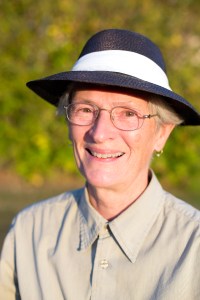
Could you tell us about yourself
I grew up on the farm that my paternal grandfather homesteaded in 1909, in southwestern Saskatchewan, Canada. I can’t think of a better place or time (1950s) in which to grow up – I had freedom to roam and to play without supervision, and that freedom extended to walking by myself to the village, only a quarter-mile south of our farmstead, where I played with friends or visited with my grandmother. At the same time, I learned about responsibilities and hard work – both my brother and I had chores that became greater the older we got.
I attended Grades 1 to 8 in the local three-room school, but attending high school meant riding the school bus to the neighbouring town. I was always the smart girl at the top of whatever grade I was in, which meant I wasn’t always the popular girl.
Reading had been a favourite pastime from before I can remember. I devoured books, to the point that my parents subscribed to a series called “All About Books,” which is where I first read about archaeology. How exciting, I thought, to travel the world, dig in exotic locations, and find treasure. I decided I would be an archaeologist where I “grew up”. However, by the time I left to go to McGill University in Montreal, I had forgotten about archaeology. Instead, I was going to be a world-famous nuclear physicist. Fortunately for the world, that did not happen. Thanks to a chance conversation with a friend, I rediscovered archaeology and have never looked back. I may not have traveled to exotic locations or found treasure, but I have no regrets about my choice of career.
I graduated from McGill with First Class Honours (there’s that “smart girl” thing again) in 1970 and went on to University of Manitoba, Winnipeg, for my Master’s degree in Anthropology. By the time I graduated in 1973, I was sick of being a student. I worked on various excavations in northern Manitoba for the next couple of years; that’s where I fell in love with the boreal forest. In 1976, I decided it was time to go back to university to earn my Ph.D., which I did at the University of Calgary, graduating in 1982.
Thus began my career as an archaeologist working in Saskatchewan. After a year of working with the Saskatchewan Research Council, followed by another year of what I call “under employment,” I was hired in 1984 by the Saskatchewan Museum of Natural History in Regina. For the first couple of years, I traveled across the province to inventory and register privately held archaeological collections. This gave me the opportunity to meet some wonderful (also some “interesting?”) people.
In 1986, the Museum began to redevelop all its galleries, and that took me on an entirely different path. The new First Nations Gallery, as it was to be called, required that we work in collaboration with First Nations which, in Saskatchewan, encompasses Cree, Saulteaux, Dakota/Lakota, Nakota (Assiniboin), and Dene nations. This was well before museums thought collaborative work was essential or even beneficial, so we were breaking new ground. We worked with Elders, artists, and dancers; we held ceremonies, attended pow-wows, and many times drove across the province for a cup of tea with someone. It was a humbling experience. The First Nations Gallery opened in 1993 and, to honour the people it celebrated, the museum was renamed the Royal Saskatchewan Museum.
With the end of gallery construction, I returned to archaeology, especially the boreal forest of northern Saskatchewan. Once again, I worked in conjunction with local communities, more often as not with Cree families on whose traplines the sites were located. Together, we excavated everything from a 5000-year-old quartz quarry to an historic village founded in 1860.
My life took a left turn in December of 2005 when I traveled to Cairo, Egypt, to visit friends. Another one of their friends was visiting at the same time. He and I spent the day in the Egyptian Museum (still our favourite museum) and the rest, as they say, is history. The following year, he invited me to drive with him across Canada to Newfoundland, and a month later he asked me to marry him. I told him, I would think about it. In the end, I said yes.
In 2007, I married, retired, and moved to Airdrie, AB where I now live, very happily, with my husband.
What made you write your book?
I didn’t start out intending to write a book. It just happened. After my father died in 1997, I discovered my paternal grandfather’s diaries which ran from 1910 to 1939. My journey into creative writing began when I read one August Sunday morning’s entry: “Had to retrieve the bull from the village.” There’s a story behind that entry, I thought, so I sat down and wrote one.
That was all I wrote, until I moved to Airdrie and discovered a writers’ group met weekly at the local library. I read the “bull” story, and they encouraged me to write more. So I did. I combed the diaries for ideas, spent hours at the Saskatchewan Archives reading the extant copies of the Meyronne Independent, talked to my cousins, did genealogical research, found second cousins I didn’t know I had, and read a lot about the social and cultural milieu of the early 20th century.
That is how “Our Bull’s Loose In Town!” Tales from the Homestead came into being.
What is the first book I remember reading?
Oh heavens, I have no idea. However, I remember an incident from before I started school. Mother was reading Black Beauty, one of my favourite stories, and at one point I scolded her, “Mother, you left out that paragraph.” So maybe it was Black Beauty.
What is my favourite book?
Quite possibly whatever I am reading at the time.
Who is your favourite author?
I have a few. Ian Rankin, the author of the Rebus series, because his plots are so dense and his characters so human. Cormac McCarthy, because his writing just blows me away. e.e.cummings, because of how he paints with words.
How many hours a day do I write?
Probably not enough. It varies, sometimes an hour, sometimes less, sometimes more. Sometimes, writing is like pulling teeth – the words just will not come, or nothing I put on paper makes any sense. Other days, the writing just flows.
What is the most difficult part of the artistic process?
You mean, aside from the writing, the revising, the chopping out of beloved but extraneous parts, the editing, the asking for critiques, or the waiting for book reviews? I can tell you what the easiest part is: doing the research. I love research. The difficult part of that is knowing when to stop.
What do I need to stay focused?
Silence. No interruptions. I don’t listen to music, I don’t eat or drink anything.
Where do I get my ideas?
I’m still an archaeologist at heart, even if retired, which means I love delving into the past. Past events are an unlimited source of ideas, but I write about them as they effect the lives of ordinary people.
Do you try to be original or give readers what they want?
Who knows what readers want? I write for myself, first and foremost, to explore question(s) I have about something that happened once upon a time. There will always be someone who wants to read it.
How do you develop your plot and characters?
For “Our Bull’s Loose In Town!” my characters and plots were predetermined for me. It’s the story of my paternal grandparents, as if told by my grandmother, so the characters and the stories were predetermined both by what my grandfather wrote in his diaries and by my memories of the village and our neighbours.
Would you and your main character get along?
My grandmother and I probably would, at least we did when I was a child. Perhaps in my adult years, we would have had some differences of opinion but nothing a cup of tea and a cookie couldn’t fix. As for my paternal grandfather, if he was anything like my father – no! We would be too similar in character – stubborn, willful, contrary-minded, and opinionated – yet too dissimilar in political leanings and worldview. A recipe for an explosive relationship.
What part of “Our Bull’s Loose in Town!” was the most fun to write?
The opening chapter where Grandma Hanna tells those “young folks” she just doesn’t understand why they are so curious to hear her story. Her voice was so clear, it was almost as if she was dictating it to me.
What was the hardest scene to write?
Without a doubt, the chapter in which Grandpa Hanna dies. It was so sad to say good-bye to him, even if we disagreed on almost everything.
What do you hope your readers take away from “Our Bull’s Loose in Town!”?
How fortunately we are to be living here and now. We do not realize how spoiled we are until we learn what our grandparents lived through – no electricity, no running water, no telephone, no neighbours, wars, drought, depression, childhood deaths, no hospitals nearby. They had to be tough to endure.
How long did it take to write “Our Bull’s Loose in Town!”?
Several years, mostly because I didn’t start out for it to become a book, it was just a way of learning more about my grandparents. Also, I had to do a lot of research in original documents, all of which are in the Saskatchewan Archives in Regina, which meant traveling there several times a year.
Are you working on anything at present?
I have just sent the manuscript of my maternal grandmother’s story, Searching for Home, to be published. It will be out in July, 2023.
I am now in the initial stages of planning the next book, also historical fiction, about the rancorous, often downright nasty, 1929 provincial election in Saskatchewan and its ramifications for the inhabitants of a small town when neighbour was often pitted against neighbour.
My advice for people who want to become writers?
Find a writing group. Take classes. Keep writing. Don’t give up. Don’t get discouraged. Don’t compare yourself to others – you’ll never write like anyone else, but then neither will anyone ever write like you. Oh, and if I didn’t already mention it, keep writing.
Where can people buy “Our Bull’s Loose in Town!”?
It is available in hard copy from Amazon, and Barnes and Noble. It is also available in e-book form from Amazon and most other providers of e-books. You can always ask your local bookstore to order it in.
Margaret G. Hanna Media Links
 The Book Corner Chronicles
Hey there! Came across your post on the WordPress feed and couldn’t resist saying hello. I’m already hooked and eagerly anticipating more captivating posts. Can’t seem to find the follow button, haha! Guess I’ll have to bookmark your blog instead. But rest assured, I’ll be keeping an eye out for your updates!
may i leave a link to my blog here? feel free to post a comment on my site and leave your link 🙂 helps both our sites !!
Hope to see your comment soon 🙂
https://pomeranianpuppies.uk/2023/05/05/the-benefits-of-owning-a-pomeranian/
LikeLike
Love The blog , Will give it a like and follow 🙂 May i leave a link to my website? please feel free to pop over to my website and leave a comment with your link to
All the best and good luck with your blogging !!!
Discover the secrets to passive income at http://PassiveIncomePro.website!
LikeLike