
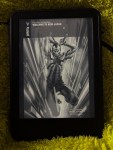
The year is 4001 A.D. – led by the artificial intelligence called “Father,” the island nation of Japan has expanded out of the Pacific and into geosynchronous orbit with the ravaged Earth below. With billions to feed and protect, it has fallen to one solitary guardian to enforce the law of Father’s empire – the mysterious folk hero known as Rai. They say he can appear out of nowhere. They say he is a spirit…the ghost of Japan. But when the first murder in a thousand years threatens to topple Father’s benevolent reign, Rai will be forced to confront the true face of a nation transformed…and his own long-lost humanity.
This comic book presents a futuristic vision that is both visually stunning and conceptually intriguing. However, despite its strong visuals this comic book does struggle a lot with an uneven storytelling and lack of character depth.
This comic book is set in the year 4001 A.D., the story unfolds in a technologically advanced society known as New Japan, a floating city orbiting Earth. The creators of this comic book creates a narrative that explores themes of control, rebellion, and identity. The central character, Rai, is a guardian tasked with maintaining order, yet he finds himself questioning his purpose and the society he serves. While the premise holds great potential, the execution is inconsistent, with a plot that feels fragmented and occasionally hard to follow.
The narrative in this comic book struggles with pacing, rushing through key plot developments without allowing sufficient time for exploration and reflection. This rapid progression makes it challenging for me personally to fully grasp the complexities of the world and its characters. The intricate political and social dynamics of New Japan are introduced but not thoroughly explored, leaving the setting feeling underdeveloped.
Rai, the protagonist, is portrayed as a stoic and enigmatic figure. However, his character lacks the depth needed to make his journey compelling. His internal conflicts and motivations are touched upon but not deeply examined, resulting in a character that feels distant and unrelatable. The supporting characters are similarly underdeveloped, serving more as narrative tools than fully realized individuals.
Despite the narrative shortcomings, the artwork itself in this comic book is a standout feature of this comic book. The illustrations we get in this comic book are richly detailed and vividly capture the futuristic setting of New Japan.The action sequences are particularly well-executed, showcasing Crain’s ability to convey motion and intensity.
The visual style complements the story’s themes of technology and control, effectively highlighting the contrast between the sleek, advanced society and the underlying tensions within it. However, while the artwork enhances the atmosphere, it cannot fully compensate for the lack of narrative cohesion and character development.
I Give This Book 2 / 5

