
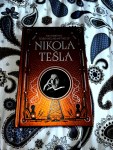
The Inventions, Researches and Writings of Nikola Tesla is the definitive record of the pioneering work of one of the modern world’s most groundbreaking inventors. During the early twentieth century, Nikola Tesla blazed the trail that electrical technology would follow for decades afterward. Although he pioneered inventions like alternating current (AC), radio, wireless transmission, and X-rays, and worked with innovators like George Westinghouse and Thomas Edison, the once celebrated Tesla was later largely forgotten by history. With illustrations and diagrams of many of Tesla’s early patents and inventions, as well as dozens of thought-provoking lectures and articles, this volume offers a rare glimpse of a true genius at work.
I gotta admit that this book was easily the hardest book I have read so far in my life. Thats because I am a dummy compared to Nikola Tesla and I needed to watch a fair share of YouTube videos to understand the things this book talked about.
This book is very well researched and written which made me like this book even more because it is clear that Nikola Tesla used a lot of time on his inventions and research. This book was a very interesting read which I have learned a fair share things from.
At the same time this book has a short biographical aspects of Tesla’s life which we get throughout this book. Which I also liked a lot because I gotta admit that before reading this book I didn’t know much about him other than him being smart as hell, he inventing some cool stuff and him being from Croatia. Because of this book I have learned more about him and his inventions which made me like this book so much better.
As I was reading this book I have realized how big of a dummy I am when it comes to technology and the things Nikola Tesla has talked about in this book. I am in no way an engineer or electrician so most of the stuff this book talked about is WAY beyond me too I needed to watch some explanation YouTube videos on some of the topics this books talks about.
The writing in this book was very good. Before reading this book I was afraid that this book would be very much like a heavy high school science book which always put me to sleep in high school. But in reality the writing in this book was very very good, because it was able to grab my attention and make me genuinely interested in the things this book has talked about. Which really is the main aspect of why I like this book as much as I do now after having read the entire book.
This book also gives us illustrations which made it easier for me to understand what this book was talking about, which made me give this book some extra points for doing. Because without those illustrations I would have been very fucked with understanding what this book was talking about.
But at the same time some of the illustrations of this book were kinda hard for me to decipher because they were pretty detailed and I had no idea what I was looking at. So thank god for google which have saved my day while reading this book.
I Give This Book 4 / 5





 The most fundamental questions about the origins of the universe and of life itself, once the province of philosophy, now occupy the territory where scientists, philosophers, and theologians meet—if only to disagree. In their new book, Stephen Hawking and Leonard Mlodinow present the most recent scientific thinking about the mysteries of the universe, in nontechnical language marked by both brilliance and simplicity. In The Grand Design they explain that according to quantum theory, the cosmos does not have just a single existence or history, but rather that every possible history of the universe exists simultaneously. When applied to the universe as a whole, this idea calls into question the very notion of cause and effect.
 The Book Corner Chronicles