
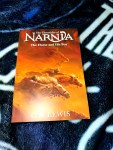
The Horse and his Boy is a stirring and dramatic fantasy story that finds a young boy named Shasta on the run from his homeland with the talking horse, Bree. When the pair discover a deadly plot by the Calormen people to conquer the land of Narnia, the race is on to warn the inhabitants of the impending danger and to rescue them all from certain death.
This book is the 5th book in the “The Chronicles of Narnia” series, and I gotta admit that it wasn’t as bad as the previous Narnia book I have reviewed, but it was still very far away from actually being a good book. This book offers a unique perspective by focusing on characters native to the world of Narnia rather than visitors from our world. It had a very uneven pacing and limited character development, which has left me personally feeling less engaged. But as always I will explain everything in this review.
The story in this book follows Shasta, a young boy living in Calormen, who discovers he is not the son of the fisherman who raised him. When he overhears plans to sell him into slavery, Shasta decides to escape to Narnia with Bree, a talking horse. Along the way, they encounter Aravis, a young noblewoman fleeing an arranged marriage, and her talking horse, Hwin. Together, they embark on a journey to the freedom of Narnia, facing numerous challenges and uncovering a plot against the Narnian kingdom.
The main issue I have with this series is that it constantly brings in new main characters which doesn’t allow me to actually connect with the series through a steady and stable main character which doesn’t change from book to book in this series. The books in this series are also very short, roughly 250 pages or so depending on the book which means that we don’t get to spend a lot of time with the characters in this series, and bringing constantly new main characters to the series with each book makes it only harder for me to connect with the characters in this series. Which is the main reason why I dislike this series (and this book) so much as I do.
The depiction of the lands beyond Narnia (Calormen and Archenland) is richly detailed, introducing new cultures and landscapes. However, the narrative sometimes lingers too long on travel, detracting from the story’s momentum and sense of adventure.
Shasta, the central character, has a classic hero’s journey, but his development feels very shallow. While he learns about courage and identity, his internal struggles are not deeply explored, making it difficult for me personally to connect with his transformation.
Aravis, on the other hand, offers a glimpse into the Calormene culture and has a backstory that adds depth to her character. However, her development is also limited, and her growth feels rushed. The narrative misses opportunities to delve into her motivations and the impact of her past experiences.
Bree and Hwin, the talking horses, add charm and humor to the story. Their personalities provide contrast to their human companions, yet their arcs are similarly underdeveloped. Bree’s journey from arrogance to humility is an interesting subplot but lacks the depth needed to be truly compelling.
But I gotta admit here that I was not a fan of any of the characters we get in this book. Because as I’ve said above this book is very short and there are simple too many characters for such a short book which means we don’t get to know the characters on any level whatsoever. Which made me feel like they are very shallow and their personalities are none existent.
The writing style itself in this book retains its descriptive quality, vividly illustrating the diverse landscapes and cultures encountered on the journey. However, the pacing of the narrative is uneven, with prolonged travel sequences that slow down the plot. This lack of momentum can make it challenging for me personally to stay engaged in the book or even like it enough to give it a good rating and a good review.
Dialogues in this book often feels stilted, missing opportunities for deeper emotional connections between characters. This lack of depth in interactions contributes to a sense of detachment from the narrative.
I Give This Book 2 / 5

